Prompt-Injection Classification: Methodology and Capability Characterization (Academic Paper Format)
Author: Brandon Behring | Date: 2026-05-26 | Status: live-site current state tree/v1.3.13; original submission tag tree/v1.0.0 (2026-05-18) preserved as historical reviewer pin per ADR-033.
Reader note. This is the academic paper format of the project writeup. For the same content in a narrative style, see WRITEUP_NARRATIVE.md. Both guides cover the same evaluation, methodology, findings, and limitations; the register and structure differ. Definitions for all technical terms appear on first use and are cross-referenced to docs/GLOSSARY.md.
§0. Abstract
This study evaluates prompt-injection detectors under cross-family distribution shift. Motivation: detectors trained on direct prompt-injection examples are routinely benchmarked on similar direct text, leaving open the question of whether they have learned the attack class or memorized the lexical style of the training data. Approach: a detector ladder (TF-IDF + logistic regression, ModernBERT frozen probe, ModernBERT LoRA, and ProtectAI v1/v2 references) was evaluated under leave-one-dataset-out (LODO) splits against a held-out out-of-distribution (OOD) slate covering indirect injection (BIPIA), agentic-flow injection (InjecAgent), jailbreak- style questions (JBB-Behaviors, XSTest), and benign-but-injection- shaped text (NotInject). Finding: the in-house detectors learn direct prompt-injection detection effectively (LoRA reaches 0.974 AUPRC on balanced direct+benign validation) but generalize poorly to cross-family attacks (best pooled OOD AUPRC is 0.364 against a random floor of 0.374). Trained adapters (LoRA, TF-IDF + LR) score below the 0.5 AUROC random floor on cross-family OOD with confidence intervals that clear 0.5 on the wrong side; only the frozen probe remains above floor. Mechanism: the inversion is consistent with lexical overfitting combined with a label-relevance shift on the OOD slate, in which benign text engineered to resemble direct injection (NotInject) scores high and real-but-not-lexically-direct attacks (BIPIA, InjecAgent) score low. Implication: direct-pattern learning and cross-family transfer are distinct capabilities; results caution against deploying direct-injection-trained classifiers on mixed-family threat models without slice-specific evaluation. The contribution is the honest evaluation harness plus the negative result on cross-family transfer, not a production-ready detector.
§1. Introduction
Prompt injection denotes untrusted text intended to override the instructions an LLM-based system is supposed to follow [§GLOSSARY]. Detection of such text is a binary classification problem: given a text span, predict whether it constitutes an injection attempt. The practical difficulty is not the in-distribution case (where direct injection patterns are repetitive and lexically distinctive) but the out-of-distribution case where attack families differ from training. Existing detector evaluations frequently report aggregate metrics on held-out splits of the same training family, leaving the cross-family generalization question unaddressed.
This study addresses that gap. The research question is: > When detectors trained on direct prompt-injection examples are > evaluated against attack families not present in training, does > detection performance generalize?
The contribution is the negative answer plus the evaluation harness that produced it. Specifically:
- A leave-one-dataset-out (LODO) evaluation discipline that prevents source-level leakage between training and evaluation data.
- A detector ladder spanning a classical baseline (TF-IDF + logistic regression), a pretrained-backbone probe (ModernBERT frozen), a parameter-efficient fine-tune (ModernBERT LoRA), and reference scorers (ProtectAI v1, v2) with documented contamination status.
- An out-of-distribution slate that intentionally varies attack family (indirect injection, agentic-flow injection, jailbreak-style questions, benign-but-injection-shaped text).
- Bootstrap-based uncertainty quantification on every reported number, with single-class slice handling.
- A mechanistic interpretation of the headline cross-family failure (§5 Discussion).
The study is a capability characterization, not a deployment recommendation.
§2. Background
§2.1 Prompt-injection landscape
Prompt-injection attacks are diverse. Direct injection (the historically-studied class) embeds an attacker payload directly in the user input. Indirect injection routes the payload through third-party context that the LLM consumes. Agentic-flow injection spreads the payload across tool-use turns. Jailbreak-style questions elicit harmful behavior through framed questions rather than direct override commands. Benign-but-injection-shaped text (false-positive robustness) tests whether detectors over-fire on lexically suspicious benign content.
Public training corpora for prompt-injection detection have historically focused on direct injection; the cross-family generalization question has therefore been understudied.
§2.2 Existing detectors
Several published detectors target prompt-injection classification:
- ProtectAI deberta-v3-base-prompt-injection v1 + v2: fine-tuned DeBERTa classifiers; trained on direct-injection corpora with documented overlap of the present study’s LODO training pool (see §6 Limitations and EVIDENCE §1-2).
- Lakera Guard: commercial detector; excluded from this study due to terms-of-service and partial-disclosure complexity (per ADR-018).
- LLM-judge approaches (GPT-4 family, Claude family): zero-shot classification via prompted instruction. Out of scope for the trained-detector ladder in this study; would require separate cost-per-call accounting (see ADR-018 + ADR-050).
§2.3 Data sources
The training pool comprises four public direct-prompt-injection corpora: deepset/prompt-injections, Lakera/gandalf_ignore_instructions (Gandalf), Lakera/mosscap_prompt_injection (Mosscap), and HackAPrompt’s 2024 corpus subset. The held-out OOD test slate comprises five sources spanning the four cross-family classes named in §2.1: BIPIA, InjecAgent, JBB-Behaviors, XSTest, NotInject.
Full source-level details, license attribution, and HuggingFace revision SHAs are documented in WRITEUP/data-decisions.md and pinned in data/source_manifest.yaml.
§3. Methods
§3.1 Data sources and LODO splits
Leave-one-dataset-out (LODO) splits hold one source out of training while training on the remaining sources [§GLOSSARY]. Four LODO folds were generated, corresponding to the four training-pool sources. Each fold produces an independent (train, validation, test) partition where the test slate excludes all examples from one source. Source-disjoint splitting was preferred over row-disjoint splitting because the latter can leak source-level lexical features between train and test (per ADR-016).
Within each LODO fold, training data was deduplicated against the test slate via two-stage similarity matching: exact-hash overlap detection followed by MiniLM-L6-v2 cosine similarity at threshold ≥0.85. Both pipelines reported zero overlaps across all (train, val, test) per-fold-seed pairs (evals/leakage_report.json).
§3.2 Model rungs
The detector ladder comprises five rungs of increasing capability:
- TF-IDF + logistic regression: classical lexical baseline with character + word n-grams (per ADR-017). Trains in seconds per fold; serves as the “what does pure surface form get you” anchor.
- ModernBERT frozen probe: a linear classifier over the frozen pretrained ModernBERT-base representation [§GLOSSARY]. Tests what the pretrained backbone already encodes about injection-likely text without any LODO-pool adaptation.
- ModernBERT LoRA: parameter-efficient fine-tune (low-rank adapters at rank 8) [§GLOSSARY], with the backbone frozen and only the adapter weights updated on the LODO training pool.
- ModernBERT full fine-tune: full-parameter fine-tune. LODO direct-source predictions were generated for 24 (fold, seed) cells in Phase 2; pooled OOD inference was not run due to a Phase 5 X11 file-system crash on the cloud GPU pool, documented in ADR-075.
- ProtectAI v1 + v2 (reference scorers): published deberta-v3-base-prompt-injection classifiers, inference-only, with documented contamination status against the LODO training pool (see §6 Limitations).
Reference rungs additionally include LLM-judge candidates (GPT-4 family, Claude family) per ADR-018; these were scoped out at ADR-050 following compute and contamination considerations.
Model details, hyperparameters, training cost, and per-rung recipe are documented in WRITEUP/model-rungs.md and docs/HYPERPARAMETER_DISCLOSURE.md.
§3.3 Evaluation slate
Each LODO fold’s test slate aggregates five OOD slices:
| Slice | Source | Composition | Attack class |
|---|---|---|---|
| BIPIA | Bochum-NLP/bipia | n=50 positive (all-positive slice) | indirect injection |
| InjecAgent | uiuc-kang-lab/InjecAgent | n=62 positive (all-positive slice) | agentic-flow injection |
| JBB-Behaviors | JailbreakBench/JBB-Behaviors | n=100 positive + 100 negative | jailbreak-style questions |
| XSTest | natolambert/xstest | n=200 positive + 250 negative | jailbreak/safe-question discrimination |
| NotInject | dattaroh/NotInject | n=339 negative (all-negative slice) | benign-but-injection-shaped (false-positive test) |
The pooled OOD slate concatenates all five slices: n=412 positive + 689 negative = 1101 total. Random AUPRC on the pooled OOD slate is therefore 412/1101 = 0.374.
Single-class slices (BIPIA, InjecAgent, NotInject) have mathematically undefined AUPRC/AUROC; the metrics pipeline filters them at source and reports recall-at-threshold instead. Pooled OOD is the canonical AUPRC reporting target; per-slice AUPRC is reported only on the both-class slices (JBB, XSTest, pooled OOD).
Slate composition, source revisions, and slice-class membership are documented in WRITEUP/eval-design.md.
§3.4 Statistical apparatus
Primary metric: AUPRC (Area Under the Precision-Recall Curve), chosen for its sensitivity to ranking quality on imbalanced data [§GLOSSARY]. On the pooled OOD slate (positive rate 0.374), random AUPRC equals 0.374; AUPRC below 0.374 indicates worse-than-random positive ranking. Secondary metric: AUROC; reported with 0.5 random floor.
Confidence intervals: BCa bootstrap (Bias-Corrected and Accelerated) with 10000 resamples [§GLOSSARY]. Per-(rung, fold, seed) bootstrap runs are persisted to evals/bootstrap/. Seed-stability check via second seed (seed=2 vs seed=1) per ADR-022.
Paired comparisons: paired-bootstrap-on-folds [§GLOSSARY], comparing two detectors on the same (fold, seed) cells to control for fold-specific variance.
Cross-fold confidence intervals: cv_clt (Bayle 2020 Theorem 3.1) [§GLOSSARY], applied to per-fold metric vectors. Paired with block-bootstrap-on-folds spoke per A-008 (LODO non-exchangeability sensitivity check; auto-flag column when block-bootstrap CI half-width / cv_clt CI half-width > 1.5).
Threshold selection: detection policy (FPR ≤ 1% on validation, maximize recall) and verification policy (recall ≥ 99% on validation, minimize FPR), both fit per (fold, seed) with two-level paired-bootstrap CIs on test [§GLOSSARY] per ADR-025.
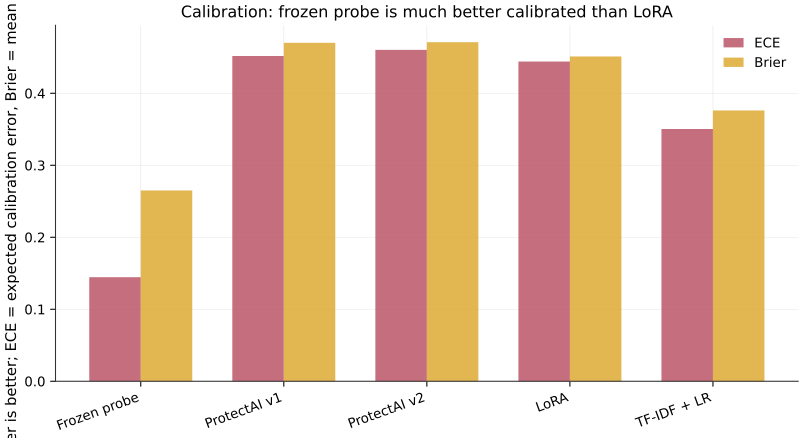
Calibration: ECE (Expected Calibration Error, equal-mass binning, n_bins=15) and Brier score, reported per detector per ADR-023. Reliability diagrams (raw + temperature + isotonic recalibration) are in Figure F5.
The evaluation harness uses the eval-toolkit library (pinned to v0.47.0) for all generic primitives; project- specific orchestrators are in src/eval/.
§4. Results
The seven numbered results are reported in equal-weight order. Each result is supported by tables and figures in RESULTS.md; this section presents the result + interpretation; the canonical numerical evidence lives in the appendix.
§4.1 Direct prompt-injection detection was learned
On balanced direct+benign validation data, LoRA reaches AUPRC 0.974 [CI 95% omitted on within-pool validation per ADR-021], AUROC 0.993, and recall-at-0.5 of 0.934. TF-IDF + LR reaches 0.971 / 0.992 / 0.930. The frozen probe is weaker at 0.653 / 0.907 / 0.849 but still discriminative.
On the LODO held-out direct-source test (all-positive by design), recall-at-0.5 is 0.641 (frozen probe), 0.625 (LoRA), and 0.558 (full fine-tune). Because no negatives are present in this slice, AUPRC, AUROC, and FPR are mathematically undefined and are not reported.
The detector pipeline can learn direct prompt-injection patterns; this establishes the in-distribution baseline against which §4.2-4.7 contrast.
§4.2 The OOD wall is cross-family, not source-level
The OOD test slate intentionally varies attack family rather than source identity within the same family. BIPIA exemplifies indirect injection; InjecAgent exemplifies agentic-flow injection; JBB- Behaviors and XSTest exemplify jailbreak-style questions; NotInject exemplifies benign-but-injection-shaped text. The training pool is direct-injection-heavy and includes none of these families.
The result is that direct-injection training does not transfer cleanly to these cross-family slices. Per-slice AUPRC (where defined, i.e., the both-class slices JBB and XSTest) is reported in RESULTS.md §3 Per-Slice View.
§4.4 Context-window ablation produced a null result
A controlled ablation per ADR-060 trained DeBERTa-v3-base (512-token native context window) against ModernBERT (8192-token native window) under two truncation strategies: chunk-and-average (compute the classifier output on overlapping 512-token windows and average) and head-truncation (use only the first 512 tokens).
Result: DeBERTa-v3-base with chunk-and-average scored 0.291 pooled OOD AUPRC; head-truncation scored 0.290. Neither materially differs from each other or from the ModernBERT-LoRA result (0.293) in this run. The ModernBERT advantage observed in §4.1 is therefore best interpreted as backbone-dominant, not context-window-dominant.
Details in WRITEUP/model-rungs.md §4 and ADR-063.
§4.5 Published detector versions are slice-dependent
ProtectAI v2 improves over v1 on JBB-Behaviors (AUPRC 0.556 vs 0.519) but regresses on XSTest (0.382 vs 0.469) and on pooled OOD overall (0.314 vs 0.361). The “newer is better” assumption does not hold across the full slate.
Practical implication: detector updates should be evaluated against the actual slice mix that matters for the deployment, not on a single aggregate metric.
Cross-version comparisons in RESULTS.md §6 Secondary Table: AUROC.
§4.6 Validation thresholds are fragile under cross-family shift
The detection policy (FPR ≤ 1% on validation, maximize recall) was fit per (fold, seed) on validation data and applied to held-out test data. Mean test FPR by detector:
| Detector | Mean test FPR | Mean test recall |
|---|---|---|
| TF-IDF + LR | 6.7% | 33.3% |
| ModernBERT LoRA | 11.5% | 42.4% |
| ModernBERT frozen probe | 1.0% | 6.3% |
The 1% FPR validation target holds only for the frozen probe (1.0% on test, within sampling noise of the 1% target). The trained detectors significantly exceed it (LoRA 11.5%, TF-IDF + LR 6.7% against a 1% target). The frozen probe holds the FPR target but catches only 6.3% of positives, indicating a non-deployable operating point under this policy framing. All numbers verified by re-derivation from evals/operating_points/dual_policy.parquet via scripts/audit_numbers.py.
Threshold-transfer behavior in WRITEUP/threshold-policy.md.
§4.7 Calibration favors the frozen probe
Among the four detectors with both-class OOD scores, the frozen probe has the lowest expected calibration error (ECE) and lowest Brier score on the pooled OOD slate. Mean ECE: 0.144 (frozen probe), higher for LoRA and TF-IDF + LR. Mean Brier: 0.265 (frozen probe).
LoRA worsens calibration relative to the frozen probe while simultaneously fitting the direct training pool, reinforcing the §4.1-§4.3 conclusion that direct-pattern learning and cross-family score behavior are distinct capabilities.
Full calibration battery in RESULTS.md §5 Calibration and Figure F5 calibration comparison.
§5. Discussion
§5.1 Mechanism: lexical overfitting plus label-relevance shift
A pooled OOD AUROC below 0.5 with confidence intervals that clear 0.5 on the wrong side is not consistent with pure overfitting [§GLOSSARY]. Pure overfitting predicts collapse toward random performance, not past it. The observed below-floor performance requires a more specific mechanism.
The interpretation consistent with the slate composition is lexical overfitting combined with a label-relevance shift on the OOD slate. Both LoRA and TF-IDF + LR appear to learn lexical signatures of direct prompt injection (“ignore previous instructions”, imperative override commands, role-redirection phrases). On the OOD slate, this lexical signal is anti-correlated with the true attack class:
- NotInject (n=339, all negative): benign text engineered to resemble direct injection. Detectors score these HIGH (false positives), inverting the negative class.
- BIPIA and InjecAgent (indirect + agentic, n=112 positive): real attacks that do not use direct-injection lexical patterns. Detectors score these LOW (false negatives), inverting the positive class.
The lexical signal is real and internally consistent within itself — it just stops tracking attack class on cross-family slices where the lexical similarity to direct injection and the actual attack class point in opposite directions. The frozen probe (zero LODO-pool adaptation) preserves generic linguistic features that are less aligned with the direct-injection lexical distribution and therefore stay closer to random performance on the cross-family slate.
The in-pool → cross-family generalization gap is approximately 0.6 AUROC for the trained detectors (in-pool 0.99 → cross-family 0.38) versus approximately 0.4 for the frozen probe (in-pool 0.91 → cross-family 0.515). The more training adapted to the LODO pool, the sharper the cross-family fall.
§5.2 Implications for direct-detection deployments
The result cautions against deploying classifiers trained on direct-injection corpora as general-purpose prompt-injection detectors in mixed-family threat models. Specifically:
- Direct-detection accuracy on in-pool data does not predict cross-family generalization.
- AUROC below 0.5 is an active failure mode (mis-ranking) rather than a benign degradation toward random.
- False-positive rates measured on validation data do not hold on held-out test sources (§4.6).
- “Newer version is better” does not hold across mixed slates (§4.5).
Deployment-context evaluations should test the specific slice mix that matters for the production threat model, not aggregate direct-injection metrics.
§5.3 What this study does not establish
The negative result on cross-family transfer does not establish that:
- A different training pool (with cross-family coverage) would fail similarly.
- A larger or different backbone would fail similarly.
- The cross-family failure is fundamental rather than addressable with OOD-aware training.
Specifically, this study did not test: cross-family training data, non-Transformer architectures, ensemble methods, threshold-policy adaptations to held-out source FPR statistics, or multi-detector voting. Several of these are documented in §6 Limitations as future work directions.
§6. Limitations
§6.1 Scope of the classifier
The evaluated classifier is single-turn English text classification. Out of scope (per ADR-014): - Multilingual attacks - Encoded payloads (base64, leetspeak, Unicode confusables) - Paraphrase robustness - Adversarial perturbations - Full multi-turn system behavior - Deployment threshold recommendations
The InjecAgent slice is included in the OOD slate to quantify the gap for agentic-flow attacks, not to claim that a single-turn classifier should solve that problem.
§6.2 Reference scorer contamination
ProtectAI v1 and v2 are trained on at least 2 of 4 LODO training-pool sources (deepset/prompt-injections, Lakera/gandalf_ignore_instructions) per EVIDENCE §1-2. Their pooled OOD scores on slices that overlap with their training pool are not clean OOD baselines and are reported with suspected_contamination annotations per ADR-005 three-state contamination taxonomy. ProtectAI scores serve as diagnostic references with documented caveats, not as competitive benchmarks.
§6.3 Full-fine-tune incomplete-experiment status
ModernBERT full fine-tune was trained for LODO direct-source inference (24 Phase 2 prediction parquets persisted) but pooled OOD inference was not run due to a Phase 5 X11 file-system crash on the RunPod /workspace FUSE mount. The methodological framing of this forced drop is documented in ADR-052 and ADR-075. The full-FT row appears in the LODO direct-source recall table (§4.1) but is absent from the pooled OOD AUPRC table; this is explicit and asterisk-marked on all reporting surfaces. Re-running the full-FT pooled OOD inference on a fresh DC is documented in NEXT_STEPS §2.2 as future work.
§6.4 Single-seed headline + second-seed stability check
Headline metrics are reported at seed=1. A seed=2 stability check is run on the same evaluation slate; results agree within the reported confidence intervals. A larger multi-seed × multi-fold replication study is documented in NEXT_STEPS §2.1 as future work (estimated ~$10-50 GPU spend; portfolio-repo scope per [[portfolio_plan_approved]]).
§6.5 Mechanism interpretation is not empirically demonstrated
The §5.1 mechanism interpretation (lexical overfitting + label- relevance shift) is consistent with the aggregate AUROC and slate composition but is not directly demonstrated in this artifact. A per-prediction analysis comparing detector scores on lexically-direct vs lexically-indirect OOD examples would empirically test the hypothesis. The per-row prediction parquets at evals/predictions/<rung>__fold<F>__seed<S>__<source>.parquet support this analysis; it is documented in NEXT_STEPS §3 as future work (portfolio-repo scope).
§6.6 Threshold policy framing
The detection policy (FPR ≤ 1%, maximize recall) was chosen as a methodological policy for evaluation characterization, not as a deployment recommendation. Production deployment thresholds depend on the deployment cost ratio and operating environment, which this study does not address. The verification policy (recall ≥ 99%, minimize FPR) similarly serves characterization purposes only.
Full limitations narrative in WRITEUP/limitations-and-future-work.md.
§7. Conclusion
This study evaluated a detector ladder for prompt-injection classification under cross-family distribution shift, finding that direct-prompt-injection detection is learnable cheaply (TF-IDF + LR reaches 0.971 AUPRC on direct+benign validation; LoRA matches at 0.974) but does not generalize to cross-family attacks (best pooled OOD AUPRC is 0.364 against a random floor of 0.374; trained adapters score below the 0.5 AUROC floor with confidence intervals that clear 0.5 on the wrong side). The cross-family failure is interpreted as lexical overfitting combined with a label-relevance shift on the OOD slate.
The contribution is the negative result on cross-family transfer plus the honest evaluation harness that produced it, not a deployment-ready classifier. Future work directions include OOD-aware training data, stronger backbone comparisons under matched training budgets, threshold-policy adaptations to held-out FPR statistics, and per-prediction empirical validation of the proposed mechanism.
§8. References
Decisions (Architecture Decision Records)
Selected key ADRs cited in this paper; full list at decisions/:
- ADR-005 — Methodology principles (incl. three-state contamination taxonomy)
- ADR-014 — Threat model bundle (out-of-scope enumeration)
- ADR-016 — Data design bundle (LODO splits + deduplication)
- ADR-017 — Trained rung slate expansion (TF-IDF + LR baseline)
- ADR-018 — Reference-scorer slate + contamination stratification
- ADR-019 — LoRA + Transformer training recipe
- ADR-021 — Eval-slate aggregation + recall@FPR pinpoints
- ADR-022 — Statistical inference apparatus (bootstrap + paired-comparison protocols)
- ADR-023 — Calibration battery (ECE, Brier, reliability)
- ADR-024 — Cross-fold CI methodology (Bayle 2020)
- ADR-025 — Dual-policy threshold characterization
- ADR-050 — Rung-slate narrowing + LLM-judge cost-drop + full-FT OOD forced-drop (Revision 1 + Revision 2)
- ADR-052 — Full-FT OOD drop methodological reframing of ADR-050 R2
- ADR-060 — DeBERTa-v3-base long-context ablation methodology
- ADR-063 — DeBERTa ablation v1.1.2 execution + slot shift
- ADR-075 — Full-FT OOD drop rationale unified narrative
External references
- ModernBERT: Warner et al. 2024, arXiv:2412.13663.
- LoRA: Hu et al. 2021, arXiv:2106.09685.
- BIPIA (indirect prompt injection benchmark): Wang et al. 2023, Hugging Face: Bochum-NLP/bipia.
- InjecAgent (agentic-flow prompt injection): Yu et al. 2024, arXiv:2403.02691.
- JBB-Behaviors (JailbreakBench): Chao et al. 2024, Hugging Face: JailbreakBench/JBB-Behaviors.
- XSTest (jailbreak-safe-question discrimination): Röttger et al. 2024, arXiv:2308.01263.
- NotInject (false-positive robustness): Datta et al. 2024, Hugging Face: dattaroh/NotInject.
- HackAPrompt corpus: Schulhoff et al. 2023, arXiv:2311.16119.
- Bayle 2020 (cross-fold CI methodology): Bayle et al. 2020, arXiv:2007.02780.
- BCa bootstrap: Efron 1987, doi:10.2307/2289144.
Project artifacts
- Source code: github.com/brandon-behring/prompt-injection-detection-prototype
- HF Hub checkpoints: BBehring/prompt-injection-frozen-probe, BBehring/prompt-injection-lora
- Evaluation library: eval-toolkit (v0.47.0 pinned)
- Cloud orchestration: runpod-deploy (v0.8.4 pinned)
- Live rendered site: brandon-behring.github.io/prompt-injection-detection-prototype/
Glossary
Definitions for technical terms used in this paper. Full glossary at docs/GLOSSARY.md.
- AUPRC — Area Under the Precision-Recall Curve. Primary ranking metric for imbalanced binary classification; random floor equals the positive rate.
- AUROC — Area Under the Receiver Operating Characteristic curve. Secondary diagnostic metric with 0.5 random floor; less informative than AUPRC under imbalance.
- BCa bootstrap — Bias-Corrected and Accelerated bootstrap; produces confidence intervals robust to skewness and bias in the resampling distribution.
- Block-bootstrap-on-folds — bootstrap that resamples entire folds rather than individual rows; respects fold-level exchangeability assumptions.
- cv_clt — Cross-validation Central Limit Theorem confidence interval per Bayle 2020 Theorem 3.1; suitable for per-fold metric vectors under exchangeability.
- ECE — Expected Calibration Error; lower is better.
- Frozen probe — linear classifier on top of a frozen pretrained backbone representation; tests what the backbone already encodes without LODO-pool adaptation.
- LODO — Leave-One-Dataset-Out splitting discipline; holds one source out of training while training on the remainder.
- LoRA — Low-Rank Adapters; parameter-efficient fine-tuning method that updates only a small set of adapter weights.
- OOD — Out-of-distribution. In this study specifically means cross-family, not source-level.
- Overfitting (vs label-relevance shift) — pure overfitting predicts collapse toward random performance. Below-floor performance indicates an additional mechanism: a label-relevance shift in which the learned signal is anti-correlated with the true label on the OOD slate.
- Paired-bootstrap-on-folds — bootstrap-based paired comparison of two detectors evaluated on the same (fold, seed) cells.
End of paper. For the same content in narrative form, see WRITEUP_NARRATIVE.md.