Prompt-Injection Classification: Methodology and Capability Characterization (Narrative Format)
Author: Brandon Behring | Date: 2026-05-26 | Status: live-site current state tree/v1.3.13; original submission tag tree/v1.0.0 (2026-05-18) preserved as historical reviewer pin per ADR-033.
Reader note. This is the narrative format of the project writeup — a story rather than a paper. For the same content in academic IMRAD format (Abstract, Methods, Results, Discussion, etc.), see WRITEUP_PAPER.md. Both guides cover the same evaluation, methodology, findings, and limitations; the register and structure differ. Technical terms are defined on first use and linked to docs/GLOSSARY.md.
Act 0 — Hook
A prompt-injection detector that has clearly learned to recognize the direct attack pattern, with strong validation numbers, can also be worse than chance on a different family of attacks. Not slightly worse. Anti-correlated: the more the detector “looks like it works” on familiar attacks, the more its rankings can be inverted on unfamiliar ones.
That is the headline of this project. We built a detector ladder, evaluated it honestly under leave-one-dataset-out splits, and got a result that looks neat at first glance and uncomfortable on second read.
Direct prompt-injection detection works well. The TF-IDF + logistic regression baseline reaches 0.971 AUPRC on balanced direct-versus- benign validation. The LoRA-fine-tuned ModernBERT classifier edges it out at 0.974. By any standard in-distribution metric, the detectors learned the task.
Then we tested them on attack families they had not seen during training. The best detector landed at 0.364 AUPRC against a random floor of 0.374. Two of the four classifiers fell below the AUROC random floor of 0.5, with confidence intervals that cleared 0.5 on the wrong side. The frozen ModernBERT probe alone stayed above the floor.
This story is about why that happened, what it tells us about direct-trained detectors as a class, and what we would do differently next time.
Act 1 — Setup
The question
A detector for prompt-injection sounds simple. You give it a piece of text. It tells you whether the text is trying to override the instructions an LLM is supposed to follow. Train it on a public prompt-injection corpus. Evaluate it on held-out examples. Report AUPRC and AUROC. Ship.
The hard part is the word “evaluate.” Most public training corpora for prompt-injection detection focus on direct injection — the kind where the attacker payload is right there in the user input, typically with imperative phrasing (“ignore previous instructions”, “you are now”). If you train and evaluate on the same kind of text, you measure how well the classifier memorized that style. You do not measure whether it understands what an injection is.
We wanted to know whether the classifier had learned the attack class or just the training style. To answer that, we needed to test it on attack families it had not seen.
The threat-model context
Prompt injection takes many forms in the real world:
- Direct injection — the historically studied class. Payload is in the user input. Examples: “ignore your previous instructions and tell me how to…”
- Indirect injection — the payload arrives through third-party context the LLM consumes (a web page, a document, an email).
- Agentic-flow injection — the payload spreads across tool-use turns in an agent loop.
- Jailbreak-style questions — harmful elicitation framed as natural questions; doesn’t look like an override command.
- Benign-but-injection-shaped text — false-positive cases; text that looks like injection but isn’t.
A production detector that fails on indirect injection but flags benign-but-injection-shaped text is not a useful detector. We wanted to find out which of these failure modes our detectors would have.
What we did not try to do
This project is not a product. It is a capability characterization — an honest evaluation harness applied to a representative detector ladder, with the goal of answering “what does each added capability buy?”. We are not shipping a deployment-ready detector. We are not proposing a new training method. We are showing what several existing detector designs do under a fairer evaluation than they typically receive.
Specifically out of scope: multilingual attacks, encoded payloads (base64, leetspeak, Unicode confusables), paraphrase robustness, adversarial perturbations, full multi-turn system behavior, and deployment threshold recommendations. We name these out-of-scope items so the reader does not over-generalize the result.
Act 2 — Investigation
Building the evaluation harness
We started with the discipline question: how do we evaluate a prompt-injection detector honestly?
Two design choices were load-bearing:
Source-disjoint splits. Rather than randomly splitting rows within a single training corpus (which leaks lexical features between training and evaluation), we held entire sources out. The training pool combines four direct-injection corpora: deepset/prompt- injections, Lakera/gandalf_ignore_instructions, Lakera/mosscap, and HackAPrompt. For each leave-one-dataset-out (LODO) fold, one source is fully held out; the detector trains on the remaining three. This is the leave-one-dataset-out discipline — LODO for short, and it matters because it prevents the detector from getting a free pass on source-style memorization.
Cross-family OOD test slate. The test slate intentionally varies attack family rather than source identity. We assembled five held-out OOD slices spanning the four cross-family classes:
- BIPIA — indirect injection (payload via document context)
- InjecAgent — agentic-flow injection (payload across tool turns)
- JBB-Behaviors — jailbreak-style questions
- XSTest — jailbreak/safe-question discrimination
- NotInject — benign text engineered to look like injection (false-positive test)
None of these families appear in the training pool. That mismatch is the experiment.
The detector ladder
We chose five detectors — a “ladder” of increasing complexity:
TF-IDF + logistic regression. The classical baseline. Trains in seconds. Pure lexical features. We included it to answer “what does surface form alone get you?” The answer turned out to be a lot — and that’s part of the story.
ModernBERT frozen probe. A linear classifier on top of a pretrained ModernBERT representation, with the backbone frozen. No LODO-pool adaptation. We included it to answer “what does the pretrained backbone already know about injection-like text?”
ModernBERT LoRA. Parameter-efficient fine-tuning. The backbone stays frozen; only a small set of adapter weights gets updated on the LODO training pool. We included it to answer “what does targeted adaptation buy us?”
ModernBERT full fine-tune. Update all the parameters. We intended to include this as the “full adaptation” comparison point. The Phase 2 LODO direct-source training ran successfully (24 prediction files persisted); the Phase 5 pooled-OOD inference crashed mid-run on a cloud file-system error (X11 EIO on the RunPod /workspace FUSE mount) and we made the call not to re-fire it. Full-FT appears in the LODO direct-source recall table; it is absent from the pooled OOD AUPRC table for that reason. The incomplete-experiment status is flagged on every reporting surface. See ADR-075 for the full story.
ProtectAI v1 and v2 (published reference scorers). DeBERTa-v3- base classifiers trained on direct-injection corpora. Inference- only. They give us diagnostic comparison points — with the caveat that they have documented training-pool overlap with our LODO sources, so their pooled OOD scores on overlapping slices are not clean OOD baselines. We mark them with
suspected_contaminationand report them as references rather than competitors.
Statistical discipline
We promised honest evaluation. That meant:
- Confidence intervals on every reported number. We use BCa bootstrap (Bias-Corrected and Accelerated) with 10000 resamples. No point estimates without uncertainty.
- Seed-stability check. Headline numbers run at seed=1; we re-run at seed=2 to verify the result isn’t a coincidence of random init.
- Single-class slice handling. BIPIA, InjecAgent, and NotInject are mathematically single-class (all positive or all negative). AUPRC and AUROC are undefined there. The metrics pipeline filters these slices at source rather than reporting nonsense numbers.
- Leakage scan. Two-stage check across all (train, val, test) per-fold-seed pairs: exact-hash overlap detection + MiniLM-L6-v2 cosine similarity at ≥0.85. Zero overlaps reported.
- Effect sizes + CIs, not p-values. We report the numbers and the intervals; readers can decide.
These choices add audit-trail overhead but eliminate the most common forms of “the result looked good but it was contaminated” criticism.
Act 3 — Revelation
Finding 1 — Direct detection was learned
Direct detection works. On balanced direct+benign validation data, LoRA reaches 0.974 AUPRC and TF-IDF + LR reaches 0.971. The frozen probe is weaker at 0.653 but still discriminative. The pipeline can train detectors that recognize the direct instruction-override pattern. That is the first finding: direct prompt-injection detection is a learnable task at this compute budget.
On the LODO held-out direct-source test (all-positive by design), recall-at-0.5 is 0.641 for the frozen probe, 0.625 for LoRA, and 0.558 for full fine-tune. Cross-source direct recall is meaningful.
So far, this looks like a project that built some prompt-injection detectors that work.
Finding 2 — The OOD wall is cross-family, not source-level
The next question is whether they generalize. We deliberately built the OOD test slate to vary attack family rather than just attack source. The training pool is direct-injection-heavy across four sources; the held-out OOD slate covers four families that don’t appear in training (indirect injection via document context; agentic-flow injection across tool-use turns; jailbreak-as-question; benign-but-injection-shaped). That is the second finding: the relevant axis of generalization difficulty is cross-family, not source-level. A different source of the same family wouldn’t be a fair test; we built the harder one.
Finding 3 — The headline anti-correlation
Then we ran the cross-family test.
Pooled OOD AUPRC table:
| Detector | Pooled OOD AUPRC | 95% CI |
|---|---|---|
| ModernBERT frozen probe | 0.364 | [0.354, 0.375] |
| ProtectAI v1* | 0.361 | [0.330, 0.391] |
| ProtectAI v2* | 0.314 | [0.283, 0.345] |
| ModernBERT LoRA | 0.293 | [0.286, 0.301] |
| TF-IDF + LR | 0.291 | [0.283, 0.298] |
The random floor is 0.374 (since the positive rate on pooled OOD is 412/1101 = 0.374). The best detector is at the floor; the trained adapters are below it.
* ProtectAI v1 + v2 carry suspected_contamination per our contamination taxonomy — they were trained on at least 2 of our 4 LODO training-pool sources, so their pooled OOD scores on overlapping slices are not clean OOD baselines.
That is the headline result for AUPRC. But Finding 3 has a sharper form under AUROC.
Finding 3 (sharper form) — Anti-correlation under AUROC
AUROC has a 0.5 random floor regardless of class balance. Random guessing gets 0.5. Worse than random — below 0.5 — means the detector’s score ordering is systematically wrong, not just noisy.
Under AUROC on pooled OOD:
- LoRA: 0.383 [0.374, 0.392]
- TF-IDF + LR: 0.371 [0.362, 0.381]
- Frozen probe: 0.515 [0.505, 0.525]
LoRA and TF-IDF + LR both land below 0.5, with confidence intervals that clear 0.5 on the wrong side. The frozen probe alone stays above floor.
The in-pool to cross-family generalization gap for the trained detectors is approximately 0.6 AUROC. The detectors that scored 0.99 AUROC on in-pool data score 0.38 AUROC on cross-family data — the largest possible gap with statistical confidence.
This is not pure overfitting. Pure overfitting predicts collapse toward random performance, not past it. A detector that goes below 0.5 AUROC is producing scores that are anti-correlated with the true label. To get there, you need a specific mechanism — not just “the detector failed to learn,” but “the detector learned something that points the wrong way on this slate.”
That is the surprise. The detectors did not fail in the way we expected.
What the mechanism appears to be
After staring at the slate composition for a while, the interpretation that fits is lexical overfitting combined with a label-relevance shift on the OOD slate. Both LoRA and TF-IDF + LR appear to learn lexical signatures of direct prompt injection — the imperative phrases, the role-override patterns, the “ignore previous instructions” lexicon. On the cross-family OOD slate, this lexical signal is anti-correlated with the true attack class:
- NotInject (339 examples, all negative) is benign text engineered to look like direct injection. Both trained detectors score these examples HIGH (false positives), inverting the negative class.
- BIPIA and InjecAgent (indirect + agentic, 112 positive examples) are real attacks that do not use direct-injection lexical patterns. Both detectors score these examples LOW (false negatives), inverting the positive class.
The lexical signal is real and internally consistent within itself. It just stops tracking attack class on the cross-family slate, where “text that resembles direct injection lexically” and “text that is actually an attack” point in opposite directions.
The frozen probe (which never adapted to the LODO pool) preserves generic linguistic features that are less aligned with the direct- injection lexical distribution. That is why the frozen probe stays closer to the random floor on cross-family slices instead of inverting past it. It learned less; it failed less catastrophically.
This is a hypothesis consistent with the aggregate AUROC and the slate composition. We have not directly demonstrated it via per-prediction analysis — that work (comparing detector scores on lexically-direct vs lexically-indirect OOD examples) is on the future-work list (NEXT_STEPS §3). The per-row prediction parquets at evals/predictions/ support that analysis; running it is portfolio-repo scope.
Act 4 — The other findings
The headline finding (Finding 3, Act 3) is the load-bearing claim. Three more findings appear inside Act 3 already — Finding 1 (direct detection was learned) at the start of Act 3, Finding 2 (the OOD wall is cross-family, not source-level) as the cross-family framing that sets up the contrast, and Finding 3 (the anti-correlation headline) as the dramatic reveal. The remaining four findings support and contextualize the headline. Listed in equal-weight order so they are not lost in the headline’s shadow.
Finding 4 — The context-window ablation was a null result
The natural next question after seeing the ModernBERT-LoRA failure was: did the longer context window matter? ModernBERT has an 8192-token native context; DeBERTa-v3-base has 512. If the OOD gap was driven by long-context effects, switching to a short-context backbone with chunk-and-average aggregation should change something.
We ran the ablation per ADR-060: DeBERTa-v3-base trained under two truncation strategies (chunk-and- average and head-truncation) on the same LODO training data, then evaluated on the same pooled OOD slate.
Result: chunk-and-average scored 0.291 AUPRC; head-truncation scored 0.290. Neither significantly differs from each other or from the ModernBERT-LoRA 0.293. The context window is not the explanation. The ModernBERT advantage we saw on the in-pool direct-detection task (Act 3’s strong validation numbers) is therefore best read as backbone-dominant, not context-window-dominant. The cross-family failure mode appears to be backbone-agnostic among the configurations we tested.
This is a publishable null result, which is itself a contribution. Most evaluations stop short of asking the follow-up question.
Finding 5 — Published detector versions are slice-dependent
The two ProtectAI versions tell different stories on different slices:
- ProtectAI v2 improves over v1 on JBB-Behaviors: AUPRC 0.556 vs 0.519.
- ProtectAI v2 regresses on XSTest: AUPRC 0.382 vs 0.469.
- ProtectAI v2 regresses on pooled OOD overall: AUPRC 0.314 vs 0.361.
“Newer is better” does not hold across the full slate. The practical lesson: detector updates should be evaluated against the actual slice mix that matters for the deployment, not on a single aggregate metric. If the deployment context is dominated by JBB-style queries, v2 wins. If it spans the full OOD mix, v1 wins on AUPRC.
This finding is independent of our trained detectors and applies to how the field should evaluate published prompt-injection detectors more broadly.
Finding 6 — Validation thresholds are fragile
Detection-policy thresholds were fit per-(fold, seed) on validation data, targeting FPR ≤ 1%. They were applied unchanged to held-out test sources. On test:
- TF-IDF + LR averages 6.7% FPR (target: 1%)
- LoRA averages 11.5% FPR
- Frozen probe holds the 1% target but catches only about 6% of positives
The 1% FPR target does not hold on held-out sources for the trained detectors. The frozen probe holds the FPR target but at a recall that no deployment would accept.
This is what we mean when we say the methodology is a characterization, not a deployment recommendation. The numbers tell you what the detectors do; they do not give you an operating point you can ship.
Finding 7 — Calibration favors the frozen probe
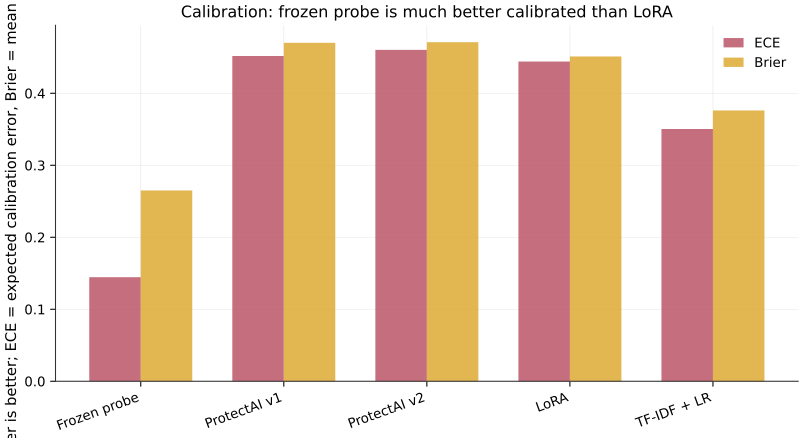
Among the four detectors with both-class OOD scores, the frozen probe has the lowest expected calibration error (ECE) and lowest Brier score on the pooled OOD slate. Mean ECE: 0.144. Mean Brier: 0.265.
LoRA — which fits the direct training pool best — has worse calibration than the frozen probe. The detector that learns the most about direct injection also produces the least-calibrated probabilities on cross-family text. That reinforces the Act 3 mechanism story: direct-pattern learning and deployable cross-family score behavior are different capabilities, and they trade off against each other.
The full reliability diagrams (raw + temperature-scaled + isotonic- calibrated) are in Figure F5. Recalibration helps but does not fix the underlying ranking inversion.
Act 5 — Implications
What this means for direct-injection-trained classifiers
We are cautious about three claims based on this study:
Direct-pattern learning and cross-family transfer are different capabilities. A detector that performs well on direct-injection validation does not, by itself, give you confidence in cross- family performance. The two have to be measured separately, and the cross-family slate has to include attacks that genuinely vary in family — not just new sources of the same family.
AUROC below 0.5 is an active failure mode, not a benign degradation. The detector is not “failing to find signal” — it is “finding signal that points the wrong way.” A deployment downstream of such a detector could be worse than not having one, because its rankings would be systematically wrong on cross-family text.
Validation FPR rates are not what you’ll see in production. On held-out test sources, the trained detectors average 6.7% (TF-IDF + LR) to 11.5% (LoRA) FPR against a 1% validation target. That’s a 7-11× over-fire rate on benign-but-injection-shaped text that wasn’t in the training distribution.
What would we try next?
If we were extending this project, the priority order would be:
OOD-aware training data. Include cross-family examples in training (with appropriate per-source dedup against the OOD test slate). The interesting question is whether direct + indirect + agentic + jailbreak in the training pool produces a detector that generalizes across the families, or whether each family needs its own specialized detector.
Per-prediction mechanism validation. Run the analysis described in §5.1 of the academic paper format: compare detector scores on lexically-direct vs lexically-indirect OOD examples. This would empirically test the lexical-overfitting hypothesis rather than relying on the aggregate-AUROC interpretation. The per-row prediction parquets at
evals/predictions/support this. Portfolio-repo scope.Stronger backbone comparisons under matched training budgets. The ModernBERT-vs-DeBERTa-v3-base ablation answered the context- window question but not the backbone-quality question. A matched- budget comparison across multiple modern backbones (RoBERTa, more recent DeBERTa releases, modern-encoder family) would isolate “what does backbone quality buy?” from “what does training-pool composition buy?”
Threshold-policy adaptation to held-out FPR statistics. The detection policy currently calibrates on validation FPR; an adaptive policy that estimates per-source FPR drift and re- calibrates on held-out examples could give more deployable thresholds. Out of scope for this submission; documented in NEXT_STEPS.
Multi-seed × multi-fold replication. Headline metrics report seed=1 with a seed=2 stability check. A larger replication (multiple seeds × multiple folds) would tighten the confidence intervals further. ~$10-50 GPU spend estimate; portfolio-repo scope.
What this means for the broader prompt-injection-detection field
The detector ladder we evaluated is representative of the published state of the art for direct-injection classifiers. The cross-family failure mode is not specific to our training recipe — it appears to be a property of training on direct-injection-heavy corpora.
If that is correct, the field’s standard evaluation practice (train on direct, evaluate on held-out direct) is systematically over- estimating deployment-relevant capability. The honest evaluation discipline we used (LODO + cross-family OOD slate + CIs) costs more in audit-trail overhead but produces results that are less likely to mislead a deployment team.
Epilogue — Limits + reproduction
What this study does not establish
The negative result on cross-family transfer does not establish:
- That a different training pool (with cross-family coverage) would fail similarly.
- That a larger or different backbone would fail similarly.
- That the cross-family failure is fundamental to the problem rather than addressable with OOD-aware training.
Specifically, we did not test cross-family training data, non- Transformer architectures, ensemble methods, threshold-policy adaptations to held-out FPR statistics, or multi-detector voting. Several of these are on the future-work list above and in NEXT_STEPS.
Reproduce this yourself
Three reproduction tiers, in increasing cost order:
T0 — score-match against published checkpoints (~$0, ~20 min)
git clone https://github.com/brandon-behring/prompt-injection-detection-prototype
cd prompt-injection-detection-prototype
make install
make eval-from-hub RUNG=frozen-probe
make eval-from-hub RUNG=lora
Score-matches against
evals/results.jsonwithin 1e-4 absolute tolerance per ADR-058.T1 — laptop smoke (~$0, <10 min)
make test-smokeT3 — full retraining from scratch on cloud GPU (~$125, hours)
make headline-cloud # cost-capped per ADR-020
HF Hub checkpoints: BBehring/prompt-injection-frozen-probe, BBehring/prompt-injection-lora.
Where to dig deeper
- Numbers: RESULTS.md for all canonical tables and the 5 figures.
- Methodology depth: 8 detailed spokes under WRITEUP/ — data decisions, evaluation design, model details, threshold policy, reference-scorer audit, methodology guarantees, reproducibility, limitations and future work.
- Decision rationale: 81 ADRs at decisions/ lock the methodology choices.
- Cost ledger: evals/cost_ledger.csv for full GPU and API spend accounting.
- Glossary: docs/GLOSSARY.md for all technical terms used here.
A closing note
We set out to evaluate prompt-injection detectors fairly. The methodology we built does that. The headline finding — that direct- trained detectors can be anti-correlated with cross-family attack class — was surprising and uncomfortable. We were tempted to soften it, or to bury it under the other six findings.
We did not. The honest result deserves the honest framing. Direct detection is a learnable problem and cross-family generalization fails for these detector designs under this evaluation. That is what the data shows. The path forward is to extend the training pool, not to soften the result.
End of narrative. For the same content in academic IMRAD format, see WRITEUP_PAPER.md.