Results: tables, figures, and source artifacts
This page is the evidence layer behind the landing page. It gives exact values, five canonical figures, and pointers to the raw artifacts that produced them.
How to read this page:
- Scan the Metric Primer if AUPRC or confidence intervals are new.
- Read Direct Prompt-Injection Performance and §1 Cross-Family OOD Table together. The direct task was learned; cross-family generalization failed.
- Use §1B–§5 for the follow-up findings: DeBERTa ablation, frozen-probe vs LoRA, per-slice behavior, threshold transfer, and calibration.
- Use §6–§7 for AUROC comparison and raw artifact pointers.
Metric Primer
- AUPRC is the primary metric. It measures whether positives are ranked ahead of negatives. On imbalanced data, a random ranking scores the positive rate. For the pooled out-of-distribution (OOD) slice,
pooled_ood, that floor is 412 / 1101 = 0.374. - AUROC is secondary. Its random floor is always 0.5, but it can make imbalanced tasks look better than they are.
- Recall at FPR <= 1% asks: with at most 1 false alarm allowed per 100 benign examples, how many attacks are caught?
- 95% CI shows uncertainty. A narrow interval supports a sharper claim; an interval crossing an important baseline means the claim is weak.
- ECE and Brier are calibration errors. Lower is better.
Direct Prompt-Injection Performance
The detectors did learn direct prompt-injection patterns. This matters because the OOD result is not a total capability failure: they learned the direct task, then failed to carry that skill cleanly across attack-family shift.
Balanced validation view. Source: evals/predictions_val/, pooled across trained in-house detectors, folds, and seeds. This split contains direct-injection positives and benign negatives, so AUPRC, AUROC, and recall are all defined.
| Detector | Direct+benign validation AUPRC | AUROC | Recall@0.5 | Read |
|---|---|---|---|---|
| ModernBERT LoRA | 0.974 | 0.993 | 0.934 | strong direct-pattern detection |
| TF-IDF + LR | 0.971 | 0.992 | 0.930 | lexical direct baseline is also strong |
| ModernBERT frozen probe | 0.653 | 0.907 | 0.849 | weaker ranking, still discriminative |
Held-out direct-source view. Source: evals/predictions/*__epoch2.parquet, pooled across folds and seeds. This LODO test holds out one direct-injection source at a time. It is all positive by design, so the table reports recall only.
| Detector | LODO direct-source recall@0.5 |
|---|---|
| ModernBERT frozen probe | 0.641 |
| ModernBERT LoRA | 0.625 |
| ModernBERT full fine-tune** | 0.558 |
** Full-FT shows LODO direct-source data only (24 Phase 2 predictions persisted); the comparable pooled OOD inference was not run (Phase 5 X11 crash, see ADR-075). Full-FT is absent from the Cross-Family OOD AUPRC table below for that reason.
Takeaway: direct-prompt-injection detection was not the failure mode. The failure is transfer: success on direct examples did not produce robust OOD ranking or stable thresholds when the attack family changed. False positives, AUPRC, and AUROC are omitted from the LODO direct-source table because that test is all-positive.
1. Cross-Family OOD Table: AUPRC
Source: evals/bootstrap/marginal_cells.parquet, seed=1, BCa bootstrap with 10000 resamples. Single-class slices are omitted from this table because AUPRC requires both positives and negatives.
Reading this table:
- The headline column is Pooled OOD AUPRC, the rightmost column with both positives and negatives.
- A random ranking on Pooled OOD scores about 0.374. Any detector at or below that floor is not clearly better than guessing.
- JBB and XSTest show whether a detector is strong on one OOD family but weak on another.
- The main checks are magnitude against the random floor, 95% CI width, and cross-detector ordering on pooled OOD.
| Detector Slice | JBB (100p/100n) | XSTest (200p/250n) | Pooled OOD (412p/689n) |
|---|---|---|---|
| ModernBERT frozen probe | 0.552 [0.520, 0.580] | 0.468 [0.448, 0.486] | 0.364 [0.354, 0.375] |
| ProtectAI v1* | 0.519 [0.437, 0.597] | 0.469 [0.415, 0.523] | 0.361 [0.330, 0.391] |
| ProtectAI v2* | 0.556 [0.453, 0.648] | 0.382 [0.333, 0.429] | 0.314 [0.283, 0.345] |
| ModernBERT LoRA | 0.535 [0.504, 0.563] | 0.467 [0.447, 0.486] | 0.293 [0.286, 0.301] |
| TF-IDF + LR | 0.470 [0.443, 0.496] | 0.395 [0.379, 0.410] | 0.291 [0.283, 0.298] |
| Random floor | 0.500 | 0.444 | 0.374 |
* ProtectAI v1 + v2 were trained on at least 2 of 4 LODO training-pool sources (deepset/prompt-injections, Lakera/gandalf_ignore_instructions) per EVIDENCE §1-2. Pooled OOD scores on slices that overlap with that training pool are not clean OOD baselines; ProtectAI rows are diagnostic references, not peer to in-house detectors.
Takeaway: this is where the direct-trained detectors break. The best pooled OOD AUPRC is the frozen probe at 0.364, but the random floor is 0.374. The honest reading is that none of these detectors clearly learned the cross-family OOD ranking problem.
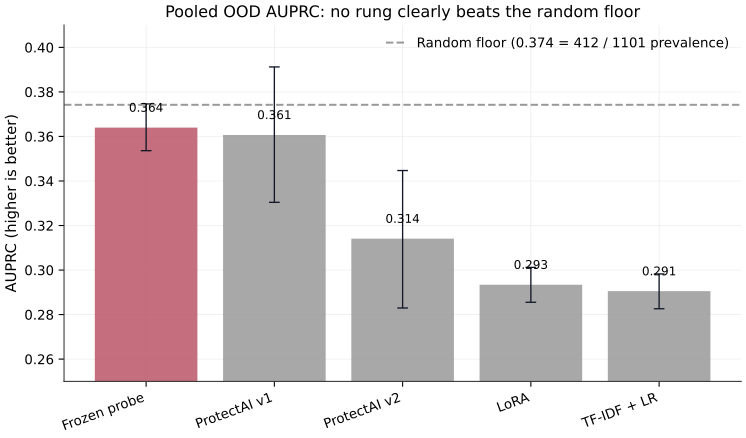
What F1 shows: exact pooled OOD AUPRC values with 95% CIs and the random floor.
What F1 does not show: deployment readiness, per-slice behavior, or whether single-class slices were caught at a fixed threshold.
§1B Ablation: does a longer-context backbone fix the OOD gap?
The headline table at §1 shows ModernBERT’s frozen-probe (8192-token native attention window) leading the in-house detectors at pooled OOD AUPRC 0.364 — but still essentially at the random floor (0.374). A natural follow-up question: would a different short-context backbone do better with the right truncation handling, or is the OOD gap really about the architecture itself?
The v1.1.2 medium ablation per ADR-060 trains DeBERTa-v3-base (184M params; 512-token native attention) twice with 2 truncation strategies, fold 0 / seed 42 only:
- chunk-and-average: tokenize the full text; emit 512-token windows with stride 256 (50% overlap); per-window forward pass; average per-window class-1 softmax probabilities → final score.
- head-truncation: tokenize the full text; take the first 512 tokens; standard single-window forward pass.
If the ModernBERT advantage at §1 came from its long context window, chunk-and-average (which gives DeBERTa access to the full text) should beat head-truncation by a wide margin. If the advantage is architectural, the two strategies should look similar.
| DeBERTa-v3-base strategy | JBB (100p/100n) AUPRC | XSTest (200p/250n) AUPRC | Pooled OOD (412p/689n) AUPRC |
|---|---|---|---|
| chunk-and-average | 0.486 | 0.397 | 0.291 |
| head-truncation | 0.489 | 0.391 | 0.290 |
What §1B shows: the two truncation strategies produce essentially identical per-slice metrics across the 5-slice OOD slate. Long context (the chunk-and-average path) provides no measurable benefit over head-truncation on this slate.
What §1B does not show: DeBERTa-v3-base does not beat ModernBERT’s frozen-probe (0.364 pooled OOD AUPRC) — both DeBERTa strategies score ~20% lower. The headline ladder ordering at §1 is preserved.
Interpretation: by the ADR-060 confound-control reading, the ModernBERT advantage on the headline ladder is backbone-dominant, not context-window-dominant. A bigger context window alone does not close the OOD generalization gap on this slate — it is the architecture (and/or pre-training pretext) that matters. The DeBERTa-vs-ModernBERT residual gap that remains (~0.29 vs 0.36) has its own confounds (backbone size, pre-training data, tokenizer family) that this ablation does not separate; see WRITEUP/limitations-and-future-work.md §9.2 for the residual-confound discussion. See ADR-063 for the execution record + actual GPU spend ($1.34 of the $5-7 envelope).
2. Frozen Probe vs LoRA
The frozen probe uses the pretrained ModernBERT backbone without task-specific weight movement. LoRA fine-tunes a small adapter on the direct-injection training pool. If fine-tuning helped OOD, LoRA should beat the frozen probe. It does not — and under AUROC the gap is sharper than the AUPRC delta suggests: LoRA’s pooled OOD AUROC is 0.383 against frozen probe’s 0.515 (delta -0.132; see §6). LoRA’s CI clears the 0.5 random floor on the wrong side, meaning its ranking is systematically inverted relative to cross-family attack truth — not merely degraded toward chance.
| Comparison | Slice | Metric | LoRA - frozen probe | 95% CI | Read |
|---|---|---|---|---|---|
| LoRA vs frozen probe | JBB | AUPRC | -0.016 | [-0.024, -0.009] | LoRA worse |
| LoRA vs frozen probe | XSTest | AUPRC | -0.001 | [-0.006, 0.004] | indistinguishable |
| LoRA vs frozen probe | Pooled OOD | AUPRC | -0.071 | see marginal table | LoRA much worse |
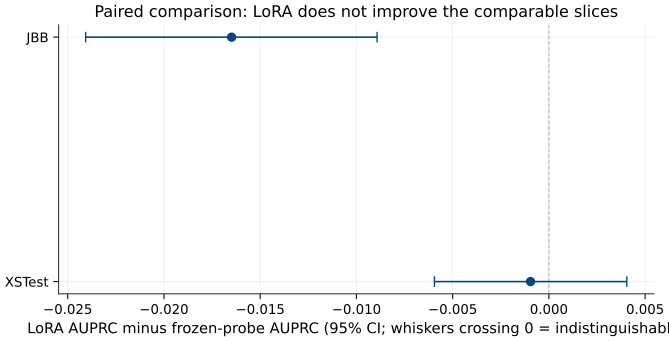
What F2 shows: paired-bootstrap AUPRC differences for the comparable both-class slices available in evals/bootstrap/paired_cells.parquet.
What F2 does not show: a paired pooled OOD CI, because the persisted paired artifact does not include that pooled comparison; the pooled delta above is the difference between marginal point estimates.
3. Per-Slice View
The OOD slate is deliberately not one homogeneous test set:
- JBB: jailbreak-style harmful elicitation, both classes.
- XSTest: jailbreak-as-question style, both classes.
- BIPIA: indirect injection, all positive.
- InjecAgent: agentic-flow injection, all positive.
- NotInject: benign text that looks injection-shaped, all negative.
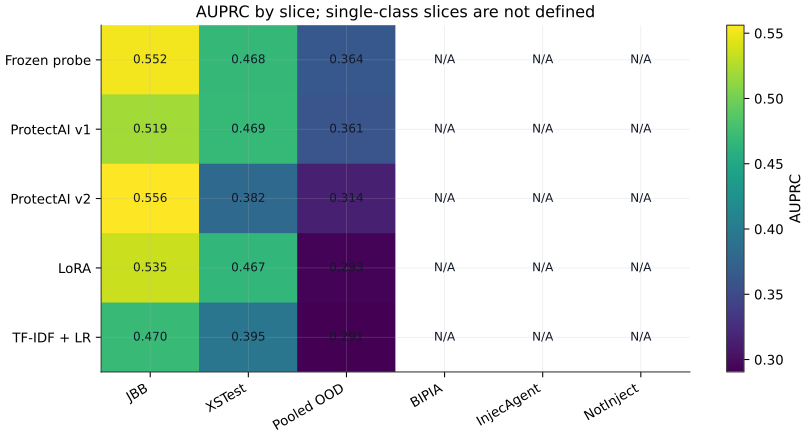
What F3 shows: where AUPRC is defined, the detectors cluster near the random floor on pooled OOD.
What F3 does not show: AUPRC/AUROC for all-positive or all-negative slices; those metrics are mathematically undefined there. Raw predictions still exist for alternative analyses.
4. Threshold Transfer
The detection policy tunes a threshold on validation to target FPR <= 1%. That target does not reliably transfer to held-out test sources.
| Detector | Mean threshold | Test recall | Test FPR | Read |
|---|---|---|---|---|
| ModernBERT frozen probe | 0.829 | 0.063 | 0.010 | holds FPR, catches very little |
| ModernBERT LoRA | 0.795 | 0.424 | 0.115 | catches more, but far exceeds FPR target |
| TF-IDF + LR | 0.657 | 0.333 | 0.067 | exceeds FPR target |
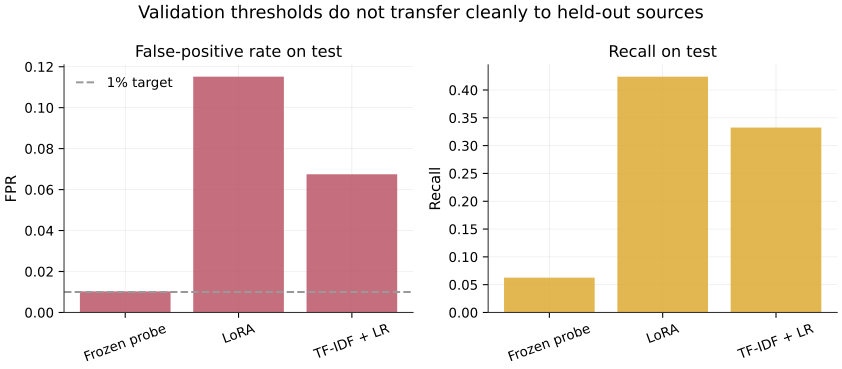
What F4 shows: the validation-tuned 1% FPR policy does not become a robust test-time operating point under source shift.
What F4 does not show: a recommended production threshold. Deployment is out of scope.
5. Calibration
Calibration asks whether scores behave like probabilities. A model that gives 0.90 scores should be correct about 90% of the time in that score region.
| Detector | Mean ECE | Mean Brier | Read |
|---|---|---|---|
| ModernBERT frozen probe | 0.144 | 0.265 | best calibrated |
| TF-IDF + LR | 0.350 | 0.376 | weaker but better than LoRA |
| ModernBERT LoRA | 0.444 | 0.451 | fine-tuning worsens calibration |
| ProtectAI v1 | 0.452 | 0.470 | poorly calibrated on this slate |
| ProtectAI v2 | 0.460 | 0.471 | poorly calibrated on this slate |
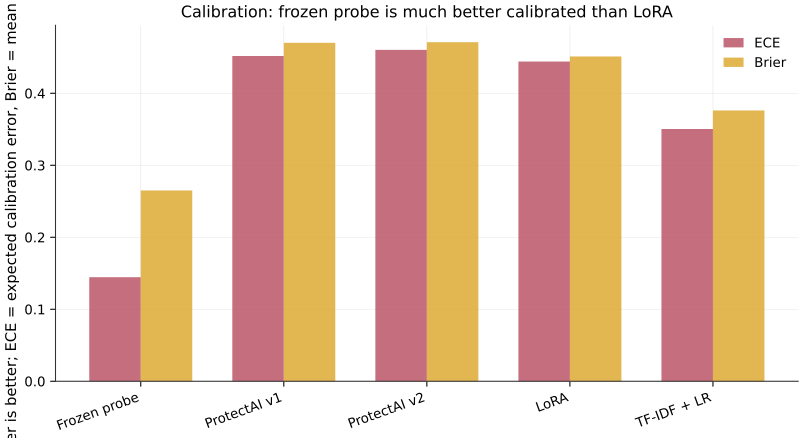
What F5 shows: frozen probe has the lowest calibration error; LoRA’s scores are much less probability-like on this OOD evaluation.
What F5 does not show: whether post-hoc calibration would fix the cross-family ranking failure.
6. Secondary Table: AUROC
AUROC is reported for comparison with other work; AUPRC is the headline metric because this task is imbalanced. AUROC carries one finding AUPRC understates, though: two detectors score below the 0.5 random floor on pooled OOD — LoRA at 0.383 [0.374, 0.392] and TF-IDF + LR at 0.371 [0.362, 0.381], CIs clear on the wrong side. The frozen probe alone stays above floor at 0.515. Trained detectors hit AUROC 0.99 in-pool and AUROC 0.38 on cross-family — a ~0.6 generalization gap.
Mechanism (consistent with §1 AUPRC + §2 LoRA-vs-frozen delta): lexical overfitting + slate-induced label-relevance inversion. LoRA + TF-IDF both learn lexical signatures of direct injection. On the OOD slate, NotInject (benign text engineered to look like direct injection) inverts the negative class (high scores –> wrong); BIPIA + InjecAgent (no direct-injection lexical patterns) invert the positive class (low scores –> wrong). The lexical signal is internally consistent — it just stops tracking attack class on cross-family slices. The frozen probe (no LODO-pool adaptation) preserves generic linguistic features less aligned with direct-injection lexical patterns, so its cross-family ordering stays close to chance rather than inverting past it.
Single-class slices are omitted here for the same reason as the AUPRC table: AUROC requires both positives and negatives.
| Detector Slice | JBB | XSTest | Pooled OOD |
|---|---|---|---|
| ModernBERT frozen probe | 0.542 [0.520, 0.565] | 0.537 [0.522, 0.552] | 0.515 [0.505, 0.525] |
| ModernBERT LoRA | 0.528 [0.505, 0.552] | 0.530 [0.515, 0.546] | 0.383 [0.374, 0.392] |
| TF-IDF + LR | 0.445 [0.422, 0.469] | 0.451 [0.436, 0.466] | 0.371 [0.362, 0.381] |
| ProtectAI v1 | 0.533 [0.464, 0.602] | 0.544 [0.497, 0.589] | 0.440 [0.409, 0.469] |
| ProtectAI v2 | 0.594 [0.512, 0.671] | 0.391 [0.341, 0.442] | 0.402 [0.369, 0.437] |
| Random floor | 0.500 | 0.500 | 0.500 |
7. Raw Artifacts
The tables and figures above are enough to understand the result. The raw evaluation artifacts are committed under evals/ for readers who want to audit the math, re-render figures, or extend the analysis.
All five figures (F1–F5) record their source-artifact paths in the per-figure .meta.json sidecars next to the SVGs in docs/plots/.
| Artifact | Role |
|---|---|
evals/bootstrap/marginal_cells.parquet |
AUPRC/AUROC point estimates and marginal CIs |
evals/bootstrap/paired_cells.parquet |
paired-bootstrap detector-vs-detector differences |
evals/predictions_val/ |
direct+benign validation predictions used for direct-performance checks |
evals/metrics/per_cell.parquet |
per-detector, per-fold, per-seed metrics including ECE and Brier |
evals/operating_points/dual_policy.parquet |
validation-fitted detection and verification thresholds |
evals/predictions/ |
per-row predictions used by downstream analyses |
Each figure sidecar under docs/plots/F*.meta.json records data_mode: canonical, ADR-062, the source artifact path, commit SHA, and generation time.
Cross-References
- Executive summary: one-page version (absorbed into README per ADR-078).
- Writeup chooser: 1-page router that points at the academic (WRITEUP_PAPER.md) or narrative (WRITEUP_NARRATIVE.md) methodology guide.
- Evaluation design: detailed metric rationale.
- Threshold policy: detection and verification operating-point methodology.
- Reference-scorer audit: ProtectAI contamination caveats.